Transmission issues continue to limit the potential of wind power in the U.S., even as the industry makes progress on most other fronts. That’s one of the findings of the 2007 Annual Report on U.S. Wind Power Installation, Cost, and Performance Trends.
In addition, “2009 is likely to be a difficult year of industry retrenchment” if the production tax credit is not renewed, the report concludes.
. . . most developers are expected to “wait it out,” restarting construction activity only once the fate of the PTC is clear.
Still, the industry grew rapidly in 2007. Though it faces upward price pressure from rising turbine costs and other challenges, prospects are being boosted by high oil prices, efforts to reduce carbon emissions and other factors.
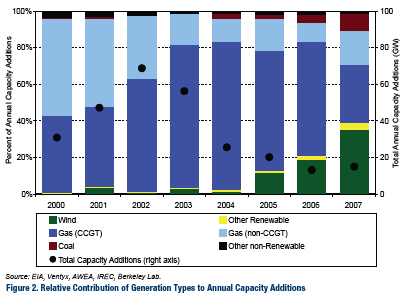
Highlights of the report, from the U.S. Department of Energy [DOE] and Lawrence Berkeley National Laboratory (Berkeley Lab):
- The U.S. is the fastest-growing wind market worldwide. The U.S. has led the world in new wind capacity for three straight years, and 1.2 percent of the nation’s electricity supply could be met with the wind capacity on line at the end of 2007.
- Growth is distributed across much of the U.S. States as diverse as Texas, Colorado, Illinois, and Oregon led the U.S. in annual wind capacity growth in 2007. Sixteen states had more than 100 MW (megawatts, or million watts) of wind capacity installed by the end of 2007, with six states topping 1,000 MW.
- Market growth is spurring manufacturing investments in the U.S. Several major foreign wind turbine manufacturers either opened or announced new U.S. wind turbine manufacturing plants in 2007. Likewise, new and existing U.S.-based manufacturers either initiated or scaled up production. All told, the new turbine and component manufacturing facilities opened or announced in 2007 alone could create more than 4,700 new jobs in the U.S.
- Wind turbine prices and installed project costs have risen since 2002. Turbine price increases have been driven by weakness in the dollar, higher prices for materials and energy inputs, and shortages in certain turbine components — all factors that are impacting many different types of generating technologies
- Wind project performance has improved in recent years. The improvement in project performance has been driven in part by taller towers and larger rotors, enhanced project siting, and technological advancements.
- Wind power is competitive and has provided good value in wholesale power markets. Despite rising project costs, in recent years wind power has consistently been priced at or below the average price of conventional electricity, as reflected in wholesale power prices.

No comments:
Post a Comment